Red light vs near-infrared light – what’s the difference?
Red light vs near-infrared light – what’s the difference?
Red light and near-infrared light are often mentioned together.
They may come from the same panel, but they are not exactly the same thing.
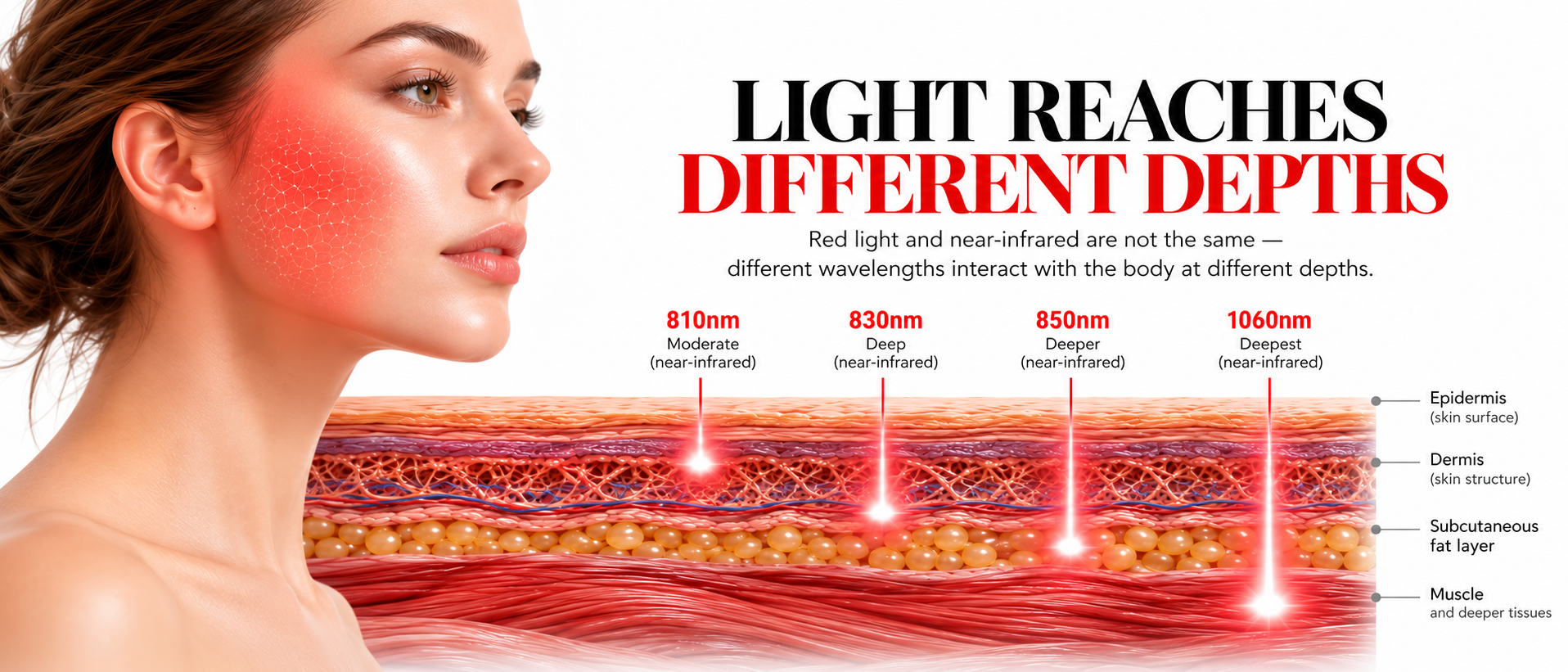
The main difference is their wavelength — and that affects how light interacts with the body and how deeply it can travel into tissue.
Red light works closer to the surface and is visible to our eyes. It is generally absorbed more superficially, which is why it is often associated with the skin and tissues closer to the surface. It does not stop at the very top of the skin, but compared with near-infrared light, it generally does not travel as deeply.
Near-infrared light can reach deeper. Near-infrared light sits just beyond the visible spectrum, so we cannot actually see it. Its longer wavelengths can travel deeper into tissue than visible red light. This is why near-infrared wavelengths are often used when the aim is to reach deeper tissues, muscles and joints.
Some devices use several near-infrared wavelengths, extending as far as 1060 nm, allowing light to interact with the body across a wider range of depths.
Why use different wavelengths together?
Because different wavelengths do different jobs.
Red light can interact more with tissues closer to the surface, while near-infrared wavelengths can reach further beneath the skin.
Using several wavelengths together means that one session can deliver light across different tissue depths at the same time.
That is one of the reasons modern red light therapy devices often use a combination of wavelengths rather than just a single red light.
Not all red light devices are the same
Today, “red light therapy” can mean anything from a small facial mask to a large full-body panel.
And they are not necessarily delivering the same type of light exposure.
Devices can differ in:
- -wavelengths
- -intensity
- -treatment area
- -distance from the body
- -treatment time
- -continuous or pulsed light
A facial mask is designed to work on a small, localised area.
A full-body panel exposes a much larger area at the same time and may also combine a broader range of red and near-infrared wavelengths.
So simply saying that two devices both use “red light” does not mean they work in exactly the same way.
At Repure Wellness, our full-body panel combines several red and near-infrared wavelengths, including 1060 nm, so different wavelengths can interact with the body at different depths.
What about pulsing?
Light does not always have to be delivered continuously.
It can also be delivered in pulses.
Instead of remaining constantly on, the light switches on and off very quickly at a selected frequency.
Why does that matter?
Because wavelength is only one part of photobiomodulation.
How the light is delivered over time also changes the stimulus received by the tissue.
Pulsing changes the timing of light exposure and the way the total light dose is delivered during a session.
So when we talk about red light therapy, there is more involved than simply whether the light looks red.
It is all about how the light is delivered
The simplest way to remember the difference is:
Red light → generally works closer to the surface
Near-infrared → generally reaches deeper
But the complete picture also includes:
wavelength + intensity + depth + treatment area + time + pulsing
That is why different red light devices can provide very different types of sessions.
And it leads us naturally to the next question:
What can red and near-infrared light actually support in the body?