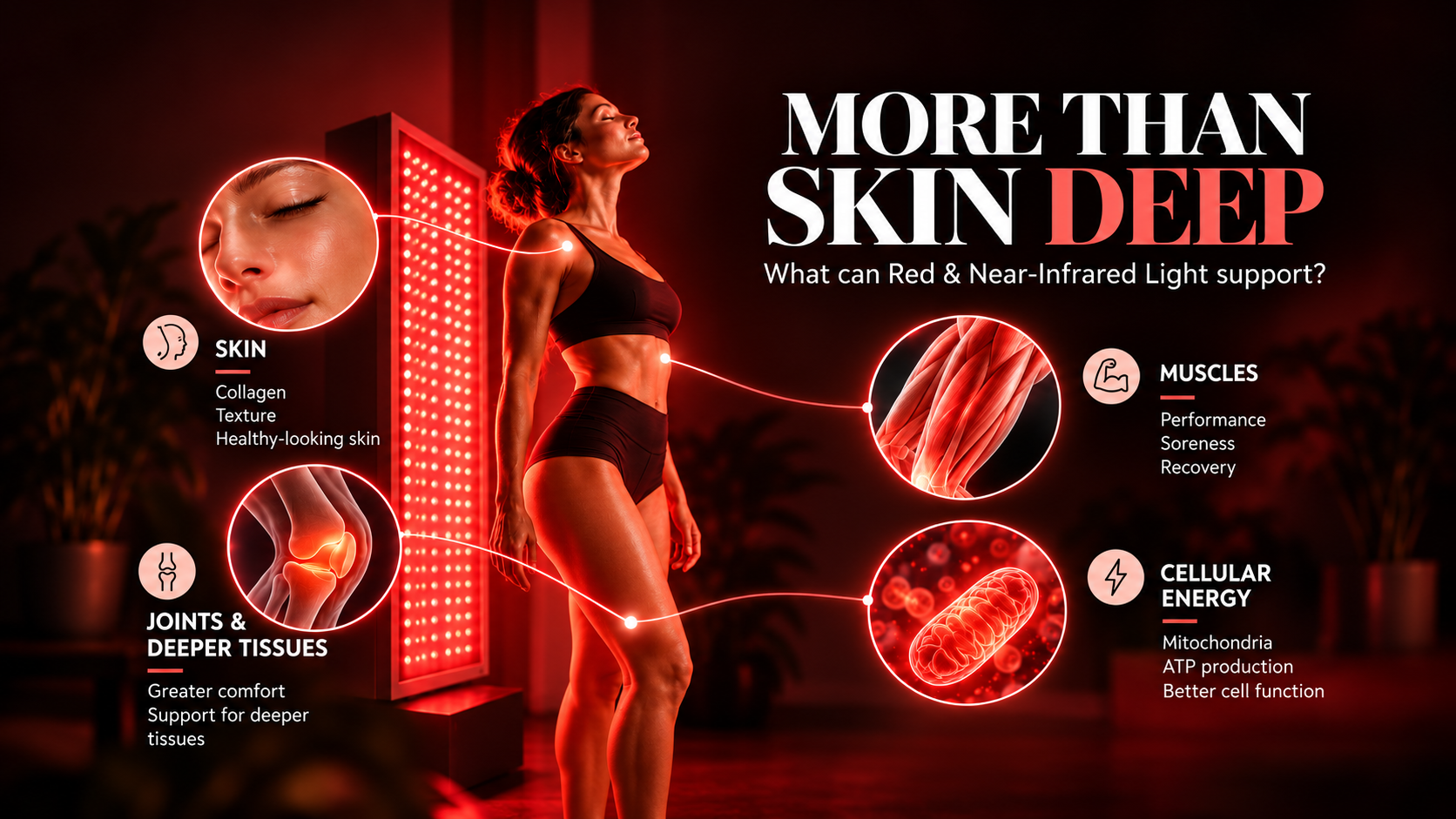
What can red and near-infrared light actually support?
Why are so many people using it?
Because photobiomodulation is being studied across a surprisingly wide range of areas — from skin appearance and cellular function to muscles, physical recovery and joint comfort.
And this is where red and near-infrared light becomes much more interesting than simply “standing in front of a red lamp”.
Skin, collagen and healthy-looking skin.
This is probably the best-known use of red light.
Red wavelengths interact strongly with tissues closer to the surface, making the skin an obvious target.
Clinical research has reported improvements in areas such as fine lines, wrinkles, skin texture and elasticity, and studies have also observed changes associated with collagen and elastic fibres. A recent systematic review found improvements across several signs of facial ageing, particularly with red and near-infrared wavelengths.
So when people associate red light with healthier-looking skin, there is real research behind that interest.
But skin is only the beginning.
Muscles and post-exercise recovery
Near-infrared light can reach deeper tissues, which makes it particularly interesting for muscles.
Photobiomodulation has been studied around exercise for its potential to support muscle performance, reduce post-exercise soreness and help strength recover after demanding activity.
A 2025 meta-analysis found that PBM used before exercise reduced muscle soreness and improved muscle performance 24 hours after exercise-induced muscle damage. Other recent reviews have also reported benefits for muscle endurance and strength recovery, although results depend heavily on the dose and treatment protocol used.
This is one reason red and near-infrared light has become increasingly popular among athletes and people who train regularly.
Joints and deeper tissues
This is where near-infrared wavelengths become particularly valuable.
Because they penetrate further than visible red light, they are studied around joints and deeper soft tissues, not only the skin.
For example, clinical research in people with knee osteoarthritis has found reductions in pain with photobiomodulation.
For a wellness setting, the important point is simpler: different wavelengths allow us to go beyond surface-level exposure.
Cellular energy – where it all starts
One reason red and near-infrared light attracts so much scientific interest is what happens at the cellular level.
Certain wavelengths can interact with molecules involved in mitochondrial function.
Mitochondria help produce ATP — the usable energy our cells need to function, maintain themselves and respond to demand.
So photobiomodulation is not simply warming the body or shining coloured light onto the skin. It is delivering wavelengths that can trigger biological responses inside cells.
That is what makes it fundamentally different from an ordinary red lamp.
What about recovery beyond the muscles?
Another interesting area is whole-body photobiomodulation.
Early studies have explored areas including sleep and general recovery. A systematic review of whole-body PBM found some reports of improved sleep quality.
This is an important distinction because Red Light Therapy is developing quickly — and different devices, wavelengths and protocols are not interchangeable.
One treatment, several levels of the body
This is what makes a multi-wavelength full-body approach so interesting.
Rather than focusing on only one tiny area, different wavelengths can interact with tissues at different depths: skin closer to the surface, deeper soft tissue and muscles beneath it.
And that is also why the device matters. A small facial mask may be perfect for targeting the face. A full-body panel allows a much larger area to be exposed during the same session and can combine several red and near-infrared wavelengths — including deeper near-infrared ranges such as 1060 nm.
Neither is simply “a red light”.
They are different ways of delivering photobiomodulation.
Red Light Therapy is bigger than skincare
Yes, skin is one of the reasons people discover Red Light Therapy.
But it is far from the whole story.
Research into photobiomodulation now covers skin appearance, collagen-related activity, cellular energy, muscle soreness, muscle performance, deeper tissues and joint discomfort. And that is why Red Light Therapy has moved far beyond the beauty world. For many people, it is becoming part of a much broader approach to looking after the body, supporting recovery and maintaining performance.