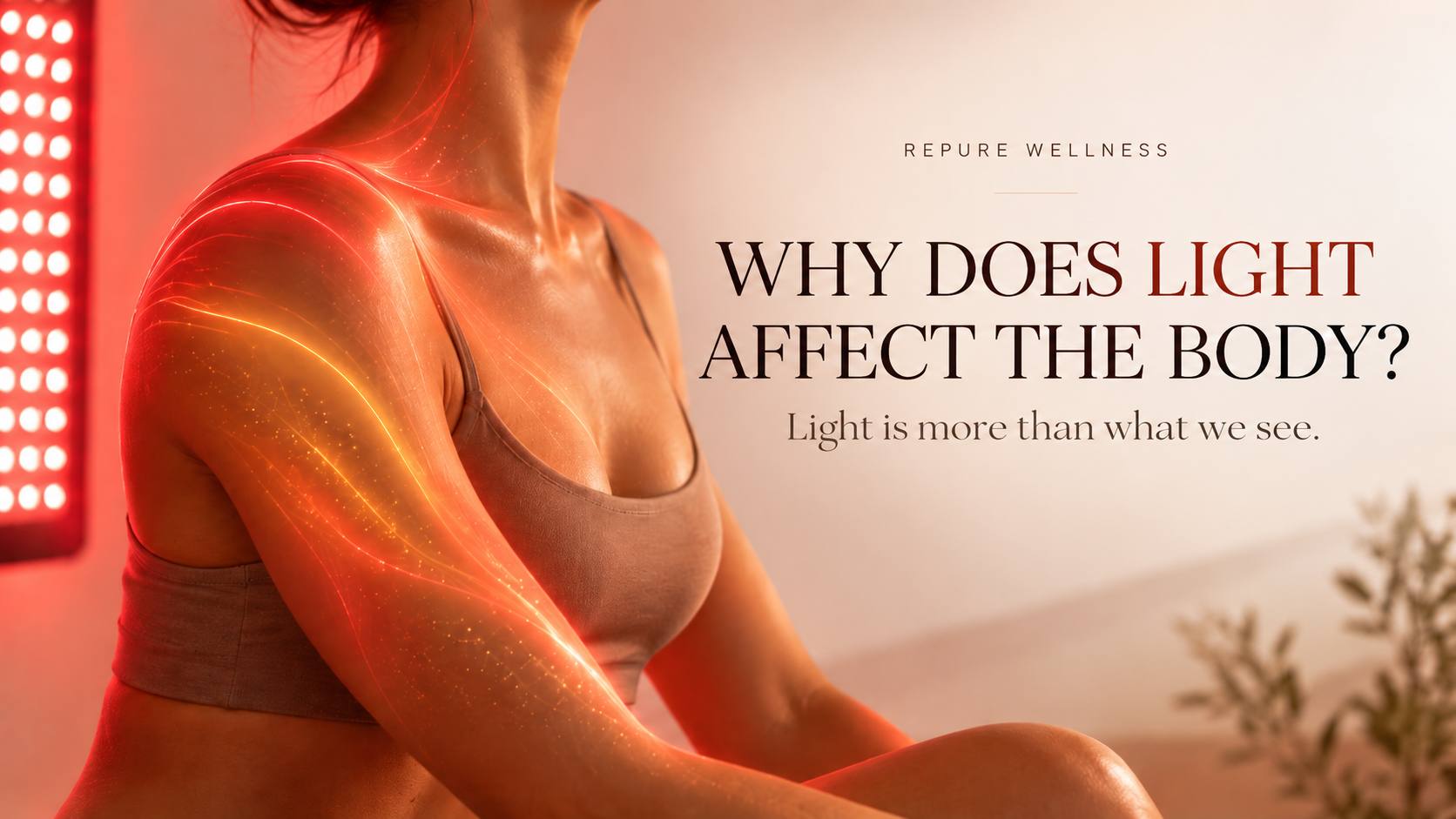
Why does light affect the body?
We usually think of light as something that simply helps us see.
But light is energy — and our bodies can respond to it in different ways.
Sunlight is an obvious example. It can influence our sleep-wake cycle, our skin and even how alert we feel during the day.
But different types of light behave differently.
Not all light is the same
Light is made up of different wavelengths.
Some wavelengths are visible to our eyes, while others are not.
Red light is part of the visible spectrum.
Near-infrared light sits just beyond what we can see.
One of the important differences between them is how deeply they can travel into the body.
Red light is absorbed more superficially, while near-infrared wavelengths can generally penetrate deeper.
But what happens when light reaches our cells?
This is where it becomes much more interesting.
Certain wavelengths of red and near-infrared light can be absorbed by molecules inside our cells.
Researchers are particularly interested in their interaction with the mitochondria — the structures that help our cells produce energy.
You may remember mitochondria from our earlier articles.
They help produce ATP, the form of energy our cells use to carry out their normal functions.
When certain wavelengths of light are absorbed by cells, they can influence cellular signalling and processes connected with energy production.
This is known as photobiomodulation.
So light can do more than illuminate a room
Red and near-infrared light are not simply about warmth or brightness.
They interact with the body in ways that researchers have been studying for decades.
And that brings us to the next question:
What is the difference between red light and near-infrared light — and why do we often use them together?